
Why Your Website Is Not Ranking on Google (And How to Fix It)
You’ve invested in a professional website, published content, and perhaps even hired a marketing agency. Yet your website is nowhere to be found. Here is how to fix it.

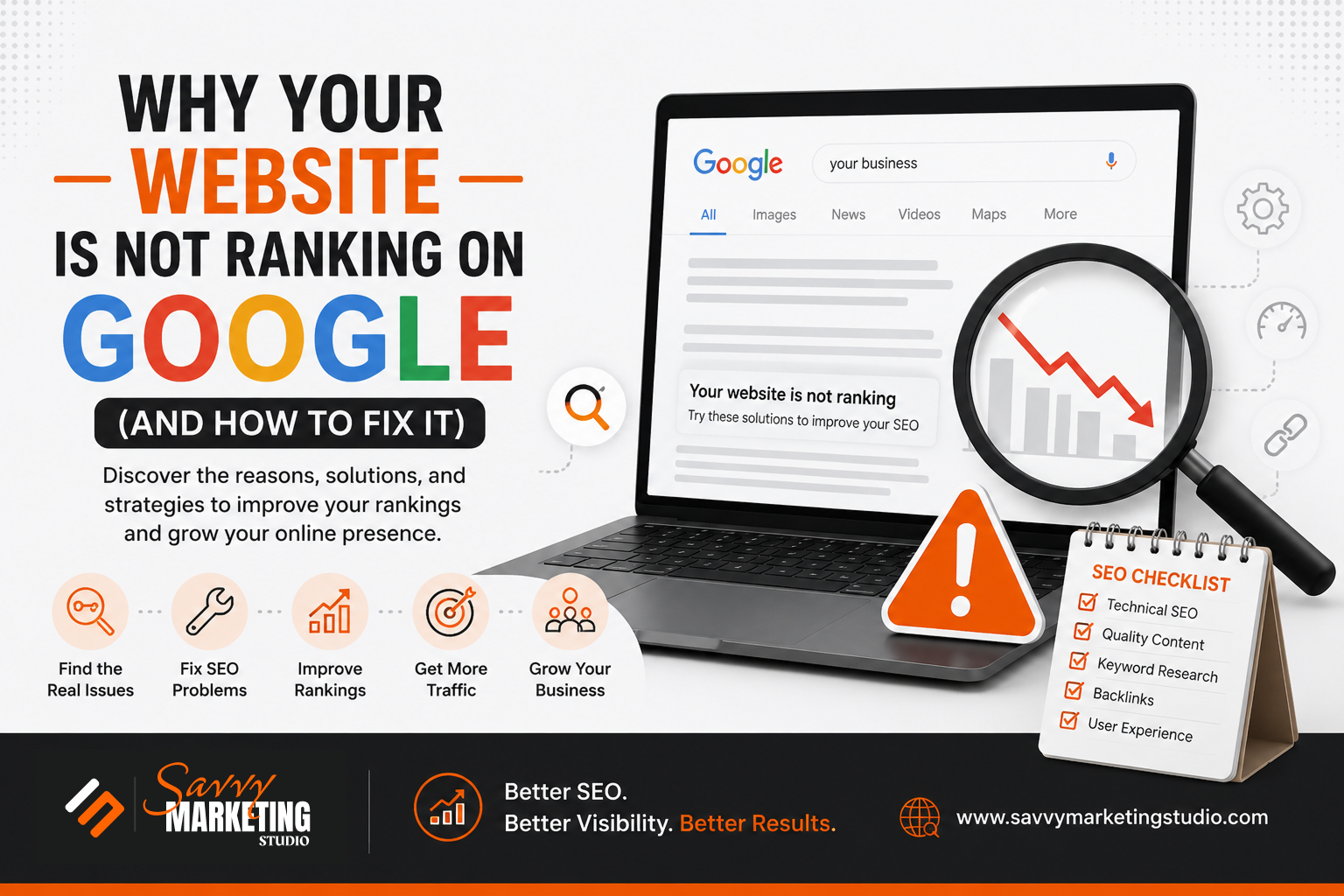
If you’re wondering why your website is not ranking on Google, you’re not alone. This is one of the most common challenges businesses face, especially in competitive industries.
The good news is that most ranking issues can be identified and fixed with the right SEO strategy. Google doesn’t rank websites randomly. It evaluates hundreds of factors, including website quality, technical performance, content relevance, authority, and user experience.
In this guide, we’ll explore the most common reasons why your website is not ranking on Google and provide practical solutions to help improve your search visibility.
Why Your Website Is Not Ranking on Google: The Most Common Reasons
There is rarely a single reason why a website struggles to rank. In most cases, several SEO issues work together to limit your visibility. Let’s examine the most common problems.
1. Poor Keyword Research
Many businesses optimize their website for keywords that nobody searches for or for highly competitive terms they have little chance of ranking for. For example, targeting “marketing” is far more difficult than targeting digital marketing agency in Gandhinagar or SEO services in Gandhinagar.
- Conduct proper keyword research.
- Focus on long-tail keywords.
- Target search intent instead of search volume.
- Use keywords naturally in headings and content.
2. Thin Content
Google prioritizes websites that provide valuable, comprehensive, and original information. If your service pages contain only a few hundred words or generic content copied from competitors, Google has little reason to rank them.
Create content that answers users’ questions in depth. Quality always beats quantity. Include:
- Detailed service descriptions
- FAQs
- Case studies
- Images and helpful examples
- Internal links
3. Technical SEO Issues
Even excellent content won’t rank if Google struggles to crawl or understand your website. Common technical issues include broken links, missing XML sitemaps, crawl errors, duplicate content, poor mobile experience, incorrect canonical tags, and indexing problems.
Perform a complete technical SEO audit and resolve errors using tools like Google Search Console and PageSpeed Insights.
4. Your Website Is Too Slow
Website speed is both a ranking factor and a user experience factor. Visitors expect pages to load quickly. If your website takes several seconds to load, users leave before engaging with your content, and Google interprets this as a poor user experience.
- Compress images.
- Enable browser caching.
- Minify CSS and JavaScript.
- Use a fast hosting provider.
- Optimize Core Web Vitals.
5. Without High-Quality Backlinks
Backlinks remain one of Google’s strongest ranking signals. If reputable websites don’t link to your content, Google may struggle to view your website as authoritative.
Build backlinks through industry directories, guest blogging, PR campaigns, local business citations, and creating high-quality content worth sharing. Avoid buying low-quality backlinks, as they can harm your rankings.
6. Poor On-Page SEO
Many websites fail to optimize basic on-page SEO elements such as title tags, meta descriptions, H1 headings, image alt text, URL structure, and keyword placement.
Ensure every page has:
- One H1 heading
- Optimized title tag
- Compelling meta description
- Descriptive image alt text
- Logical heading hierarchy
7. Weak Internal Linking
Internal links help Google discover your pages and understand their relationships. Without internal linking, important pages receive less authority.
Link between service pages, blog posts, case studies, the contact page, and the homepage. A strong internal linking structure improves both SEO and user experience.
8. If It’s New
New websites often require time before Google fully trusts them. Even with excellent SEO, new websites may take several months to establish authority.
Continue publishing high-quality blogs, helpful service pages, case studies, and industry resources. Consistency builds trust over time.
9. Ignoring Local SEO
For local businesses, Local SEO is just as important as traditional SEO. If your Google Business Profile isn’t optimized, you’re missing opportunities to appear in local searches and Google Maps.
Optimize your Google Business Profile, business categories, reviews, NAP consistency, local landing pages, and location-specific keywords.
10. Not Measuring SEO Performance
Many businesses make SEO changes without tracking results. Without data, it’s impossible to know what’s working.
Monitor your website using Google Search Console, Google Analytics 4, PageSpeed Insights, and Google Business Profile Insights. Track organic traffic, clicks, impressions, keyword rankings, and conversions.
A Proven SEO Checklist to Improve Your Rankings
If you’re asking why your website is not ranking on Google, use this checklist:
- ✅ Perform keyword research.
- ✅ Optimize title tags and meta descriptions.
- ✅ Improve page speed.
- ✅ Create valuable content.
- ✅ Build quality backlinks.
- ✅ Fix technical SEO issues.
- ✅ Add internal links.
- ✅ Optimize for mobile devices.
- ✅ Improve Core Web Vitals.
- ✅ Update old content regularly.
How Long Does It Take to Rank on Google?
SEO is a long-term investment. While timelines vary depending on competition and website quality, businesses typically begin seeing measurable improvements within the following timeframes:
The key is consistency. Regular optimization, fresh content, and technical improvements compound over time.
Why Businesses Choose Savvy Marketing Studio
At Savvy Marketing Studio, we help businesses overcome the exact challenges discussed in this guide. Our SEO services include:
Instead of chasing rankings alone, we build SEO systems that generate qualified traffic, leads, and long-term business growth.
Frequently Asked Questions
Why is my website not ranking on Google even after months?
Can a new website rank on Google?
Does website speed affect Google rankings?
How often should I update my website for SEO?
Final Thoughts
If you’ve been wondering why your website is not ranking on Google, remember that SEO success isn’t determined by a single factor. Google evaluates the overall quality, relevance, authority, and user experience of your website.
By addressing technical issues, creating valuable content, targeting the right keywords, improving internal linking, and building authority, you can significantly increase your chances of ranking higher in search results.
SEO is a continuous process, not a one-time task. Businesses that invest consistently in optimization are the ones that achieve sustainable organic growth.
Helpful Resources & Links
- SEO Services in Gandhinagar
- Website Development Services
- Performance Marketing Services
- Google Ads vs Meta Ads: Which Platform Is Better?
- Best Digital Marketing Agency in Gandhinagar for Small Businesses
Ready to improve your rankings?
If you’re ready to generate more qualified leads, Savvy Marketing Studio can help you build an SEO strategy designed for long-term success.
Savvy Marketing Studio
A Gujarat-based web design and digital marketing agency helping small and mid-sized businesses in Ahmedabad, Gandhinagar, and Vadodara grow through SEO, performance marketing, and conversion-focused websites.
Related Articles

Google Ads vs Meta Ads: Which Platform Is Better for Business Growth?
Read More →